Couple Counselor’s Direct Answer Summary
- Anxious and avoidant attachment patterns can create a cycle in which one partner seeks reassurance while the other seeks distance.
- The more one partner pursues closeness, the more overwhelmed the other may feel and withdraw.
- Recognizing these patterns, communicating emotional needs, and building security can help couples break the cycle.
One partner wants to talk immediately after an argument. The other needs space and stops responding. One keeps asking whether everything is okay, while the other becomes increasingly uncomfortable with repeated questions. Before long, both feel misunderstood: one feels abandoned, and the other feels pressured.
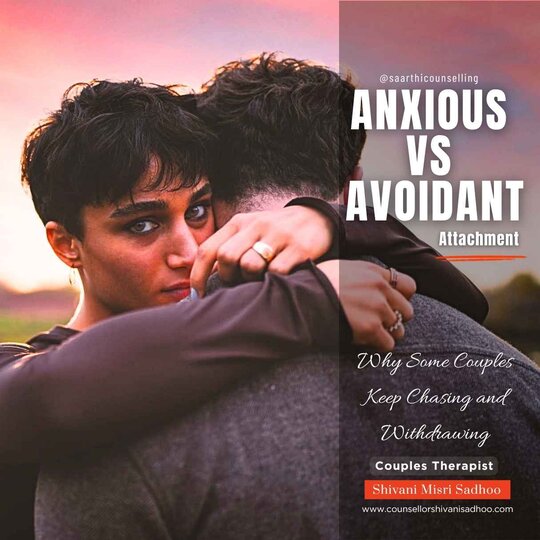
This dynamic is often described as the anxious-avoidant cycle. It can leave couples feeling emotionally exhausted, even when both genuinely want the relationship to work. Understanding the attachment patterns behind these reactions can help explain why partners sometimes move towards each other and away from each other at the same time, shares Shivani Misri Sadhoo, who is an eminent marriage counselor in Delhi.
What Are Anxious and Avoidant Attachment Styles?
Attachment styles describe patterns in how people experience emotional closeness, trust, dependence, and security in relationships. They are often influenced by early relationships and life experiences, although they can also change over time.
Anxious attachment is commonly associated with a strong need for reassurance and sensitivity to signs of rejection or emotional distance. Someone with this pattern may worry about losing their partner, interpret delayed responses negatively, or seek frequent confirmation that the relationship is secure.
Avoidant attachment is often associated with discomfort around emotional dependence and a strong preference for independence. Someone with this pattern may find intense emotional conversations overwhelming, withdraw during conflict, or struggle to express vulnerable feelings.
Neither pattern automatically makes someone a bad partner. They are ways of responding to emotional needs and perceived threats to relationship security.
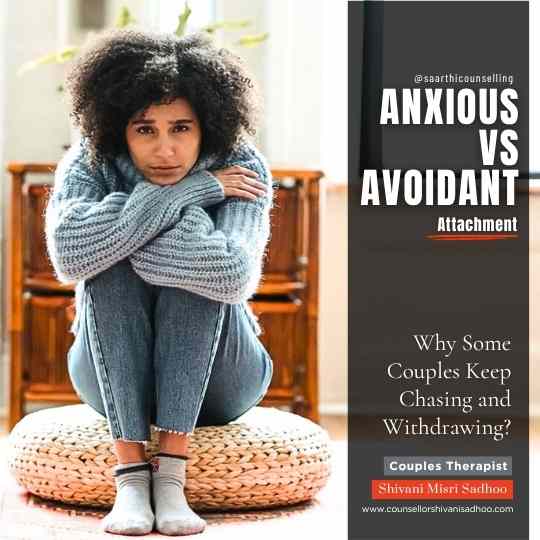
Why Does One Partner Keep Chasing While the Other Withdraws?
The anxious-avoidant cycle often begins when one partner experiences emotional distance as a sign of rejection, while the other experiences emotional pursuit as pressure.
For example, after an argument, an anxiously attached partner may want immediate discussion, reassurance, and resolution. An avoidantly attached partner may feel overwhelmed and need time alone to process the situation.
When the second partner withdraws, the first may become more anxious and increase attempts to reconnect. In response, the second may retreat further.
The cycle can look like this:
- Distance develops: One partner becomes less communicative or emotionally available.
- Anxiety increases: The other partner worries about rejection and seeks reassurance.
- Pressure builds: Repeated questions, messages, or attempts to resolve the issue feel overwhelming.
- Withdrawal deepens: The partner seeking space becomes less responsive.
- The cycle repeats: Both partners feel hurt, misunderstood, and emotionally disconnected.
The problem is not simply that one person wants closeness and the other wants independence. It is that their ways of managing emotional discomfort can unintentionally intensify each other’s fears.
What Does Each Partner Experience During This Cycle?
Although the behavior may appear straightforward from the outside, both partners can experience significant emotional distress.
| Anxious Attachment | Avoidant Attachment |
| Fears rejection or abandonment | Fears losing independence or feeling overwhelmed |
| Seeks frequent reassurance | May minimise or suppress emotional needs |
| Wants to resolve conflict immediately | May need time and space before discussing conflict |
| Interprets silence as emotional distance | May use silence to manage emotional overload |
| Feels insecure when communication decreases | Feels pressured by repeated emotional demands |
These reactions can become particularly difficult when neither partner understands what is happening beneath the behavior. One may see withdrawal as a lack of love, while the other may see repeated reassurance-seeking as a lack of trust.
Does Childhood Experience Influence Attachment Patterns?
Early relationships can influence how people learn to experience closeness and emotional security. For instance, inconsistent caregiving may contribute to fears of abandonment, while emotionally unavailable or highly discouraging environments may encourage a person to rely heavily on independence.
However, attachment styles should not be treated as fixed labels or direct proof of what happened during childhood. Adult relationships, difficult experiences, personal development, and supportive connections can all influence attachment patterns.
It is also possible for someone to behave differently across relationships. A person who feels secure with one partner may experience anxiety or withdrawal in another relationship where trust and communication are less consistent.
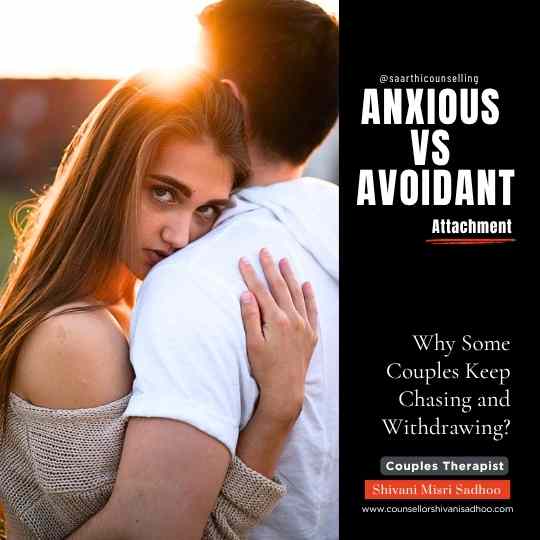
How Can Couples Break the Anxious-Avoidant Cycle?
Breaking this pattern requires both partners to recognize their reactions and take responsibility for how they communicate their needs. The goal is not to make one partner more anxious or the other more emotionally expressive overnight. It is to create a relationship where closeness and personal space can coexist.
1. Recognize the Pattern Instead of Blaming Each Other
Rather than saying, “You always ignore me” or “You never give me space,” couples can identify the recurring dynamic. Recognizing that one partner seeks reassurance while the other withdraws can shift the conversation from blame towards understanding.
2. Express Needs Without Making Demands
An anxious partner can communicate the need for reassurance directly rather than repeatedly checking or pursuing. An avoidant partner can explain the need for space without shutting down communication completely.
3. Agree on Healthy Time-Outs
Taking a break during conflict can be helpful, provided it does not become indefinite silence. Couples can agree to pause a difficult conversation and return to it at a specific time. This offers space without leaving the other partner uncertain.
4. Build Consistency Through Everyday Actions
Small, dependable behaviors can strengthen emotional security. Following through on commitments, communicating changes in plans, listening without dismissing concerns, and showing affection consistently can gradually build trust.
5. Learn to Manage Emotional Triggers
Both partners can benefit from recognizing what happens internally when they feel threatened or overwhelmed. Developing ways to regulate emotions before reacting can prevent disagreements from escalating into familiar patterns of pursuit and withdrawal.
When Can Relationship Counselling Help?
If the same arguments keep repeating despite attempts to communicate, relationship counselling can help couples understand the emotional patterns driving their interactions.
A trained relationship counsellor can help partners identify triggers, express needs more effectively, develop healthier conflict-resolution skills, and understand how their attachment experiences influence the relationship.
Counselling is not about deciding which partner is right or assigning blame. It provides a structured environment where both individuals can feel heard and work towards a more secure connection.
Moving From Chasing and Withdrawing to Feeling Secure
Anxious and avoidant attachment patterns can create a painful relationship dynamic, but they do not have to define a couple’s future. The partner seeking reassurance can learn to communicate without pursuing constantly, while the partner seeking distance can learn to take space without emotionally disappearing.
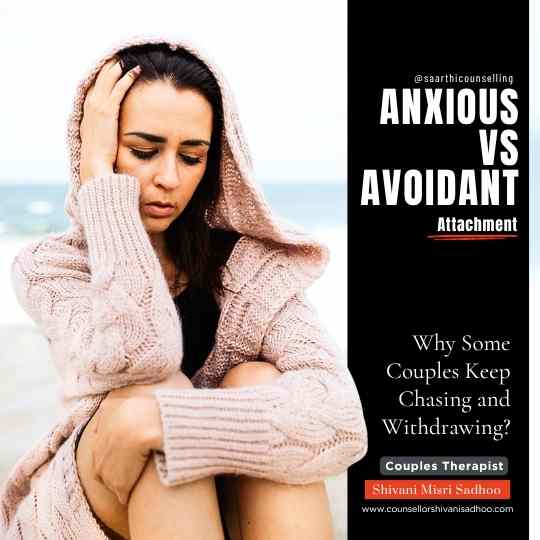
“Emotional security grows when one partner can ask for closeness without fear, and the other can ask for space without creating distance. A healthy relationship makes room for both needs.” Says Shivani Misri Sadhoo, Gottman Certified Couples Therapist in Delhi.
Lasting change comes from understanding the fears beneath each reaction and developing healthier ways to respond to them. A secure relationship does not require partners to have identical emotional needs. It requires them to respect those differences while remaining emotionally available to each other.
3 Essential FAQs: Anxious & Avoidant Relationship Dynamics
Q: Why does pursuing closeness cause an avoidant partner to withdraw even further?
Summary: Pursuit is experienced as pressure and emotional engulfment, which triggers the avoidant partner’s nervous system to retreat for safety.
Answer: The anxious-avoidant dynamic is driven by opposing coping mechanisms under emotional distress. When conflict or perceived distance occurs, an anxiously attached partner interprets silence as a direct threat of rejection or abandonment. This floods their nervous system with fear and drives an urgent need to talk immediately, text repeatedly, or demand resolution.
However, the avoidantly attached partner experiences rapid emotional pursuit as overwhelming pressure and an infringement on their autonomy. In response to this emotional overload, their natural coping mechanism is to shut down or retreat to regulate themselves. Tragically, this retreat confirms the anxious partner’s worst fear of being abandoned, prompting even more desperate attempts to reconnect. The problem is not a lack of love, but that each partner’s subconscious way of coping unintentionally magnifies the other’s deepest fear.
Clinical Takeaway: The anxious partner pursues to alleviate fear of abandonment; the avoidant partner withdraws to alleviate fear of being overwhelmed. Both are survival responses.
Q: How can an avoidant partner take space during a conflict without making an anxious partner feel abandoned?
Summary: By agreeing on a structured “Healthy Time-Out” with explicit emotional reassurance and a clear, guaranteed return time.
Answer: Taking space during heated arguments is biologically essential to prevent emotional flooding, but indefinite silence or walking out without explanation feels like sudden abandonment to an anxiously attached partner.
To take space safely:
- Provide Clear Reassurance: State clearly that the relationship and the partner are valued (e.g., “I love you and I care about solving this with you…”).
- Own the Internal Overload: Explain that space is needed for personal nervous system regulation, not as punishment (e.g., “…right now my nervous system is flooded and I need quiet time to process so I can listen well”).
- Specify an Exact Return Time: Give a definite timeline (e.g., “Let’s take a 30-minute break and sit back down on the sofa at 8:00 PM”).
This crucial combination removes ambiguity. The avoidant partner gets the decompression they need without leaving the anxious partner trapped in anxious uncertainty.
Clinical Takeaway: Space without a return time feels like abandonment; space with a guaranteed return time creates safety and allows both nervous systems to settle.
Q: Does having an anxious or avoidant attachment style mean our relationship is doomed to fail?
Summary: No. Attachment patterns are learned protective strategies that can evolve into “earned security” through conscious awareness and micro-consistency.
Answer: Neither attachment style makes someone a bad partner, and couples with this pairing can build deeply resilient, fulfilling partnerships. Attachment patterns are not rigid genetic traits or permanent psychological diagnoses; they are learned strategies for seeking safety developed from past relationships and caregiving environments.
As couples therapist Shivani Misri Sadhoo emphasizes, lasting change comes when partners stop viewing each other as adversaries (“You always ignore me” vs. “You never give me space”) and instead team up against the cycle itself. By learning to:
- Externalize the dynamic: “We are caught in the chase-withdraw loop right now.”
- Express vulnerability without making accusatory demands.
- Practice daily dependability and consistent micro-actions (following through on plans, predictable check-ins, steady affection).
Through this process, both partners can develop “earned security,” where closeness and personal independence comfortably coexist.
Clinical Takeaway: Attachment styles are malleable. When couples recognize the chase-withdraw cycle as a shared challenge, they can transition from reactive defense to earned security.

Shivani Misri Sadhoo is an internationally recommended relationship counsellor by the world’s biggest and most trusted study and research-based foundation for couples therapy – Gottman Institute. She is trained in specialised key relationship counselling Skills from AIIMS, VIMHANS and various other reputed institutions. Counsellor Shivani Misri Sadhoo is also certified in emotionally focused therapy, cognitive behavioural therapy, and dialectical behaviour therapy.
Counselor Shivani Misri Sadhoo is also a Certified Neuro Linguistic Practitioner with specialized training and experience in the field of affairs/betrayals, trust issues, difficulty communicating, conflicting values, bereavement, grief and loss (affairs, separation, divorce, childhood) and emotional health issue (anxiety, social anxiety, fear, depression, low mood).
Currently, Shivani Misri Sadhoo is one of the top counselors with the HIGHEST Success Rate with over 17,000 happy couples and individuals (based in India and abroad), who has benefited from her therapy. Psychologist and Counselor Shivani Misri Sadhoo not only practices independently from her clinic in Greater Kailash, Delhi, India, but also is listed on the panel of eminent hospitals like IBS Hospital Panel – Institute of Brain and Spine, Express Clinic, Fortis (formerly) based in Delhi.
Call Counselor: +91-8860875040
Email: saarthiforlife@gmail.com