Couples and Relationship Counselor’s Answer Summary
- The ‘ick’ refers to a sudden feeling of discomfort, disgust or loss of romantic attraction triggered by a seemingly minor behavior or habit.
- Disgust sensitivity, ego, avoidant attachment tendencies, the need for perfection and the brain’s protective responses can all contribute to this phenomenon.
- Not every small irritation signals relationship incompatibility. Understanding whether it stems from a genuine concern, personal preference or fear of emotional intimacy can help you make healthier relationship decisions.
When you start dating someone, everything about them seems lovely. You tend to overlook their flaws, make excuses for their little quirks and focus on all the things you find attractive about them. When you are in love, you feel that your partner is the most perfect person in the world and you believe you are living a picture-perfect romance.
Their smile makes your day, their voice sounds comforting, and even their small gestures seem special. You simply look forward to those coffee dates. But, then, one fine day something rather unexpected happens.
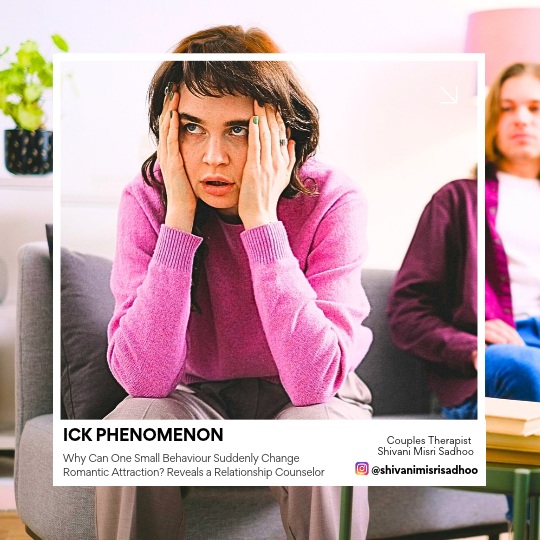
They do something that completely puts you off. It could be the way they keep avoiding any serious conversation, or, simply the way they behave in certain social situations, or could be something else. So, the person you once found interesting and meant the world to you has suddenly become someone you can barely relate to. You suddenly get the ‘ick’. The internet is quite familiar with this ICK phenomenon nowadays.
If you are curious about the Ick Phenomenon and want to know, Why Can One Small Behaviour Suddenly Change Romantic Attraction, Shivani Misri Sadhoo, the renowned marriage counselor in Delhi, explains the reasons behind such behavior in this article.
What is Ick Phenomenon?
Sometimes one might get irritated with a certain behavior of their partner, even if they never bothered you earlier. It could be something very small. Yet, it annoys you to such an extent that you literally stop interacting with your partner and prefer to stay away from them. True to its English meaning, ‘ick’ describes a feeling of disgust, discomfort or sudden loss of attraction toward someone owing to a small, awkward and unpleasant behavior.
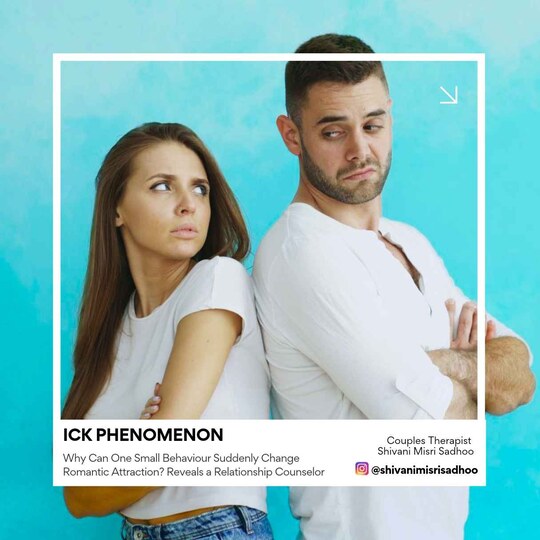
That does not mean that the person behaving in a certain way is wrong or offensive. It’s just that it does not match your expectation or your idea of love. You are no longer attracted to that person.
Reasons Behind The Scene
1. The Disgust Factor
Believe it or not, psychology has a strong association between ‘ick’ and people’s level of disgust. This is an innate response and has evolved so we can avoid potentially bad or unappealing situations. However, this instinct can also affect romantic attraction. For example, people with a higher level of disgust sensitivity may find minor habits of their partners extremely annoying. They may notice and react strongly to these small imperfections, even when they pose no real concern. As a result, a minor irritation can suddenly turn into a feeling of repulsion towards a partner.
2. When Ego Comes in between
If you are someone who is constantly looking for praise and validation, and always want to be held in high esteem, you may experience the ‘ick’ when your partner’s behavior does not match your ideal image of them. This kind of a narcissistic attitude is a reason why small habits no matter how insignificant they are easily puts you off.
3. When Intimacy Becomes a Fear Factor
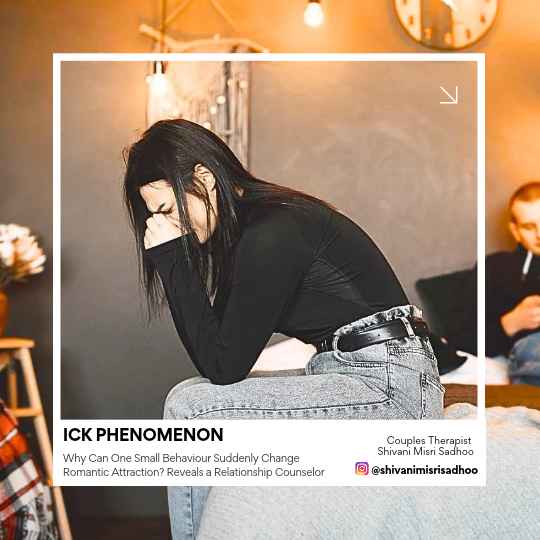
Did you know that the ‘ick’ can sometimes arise from a phobia of emotional proximity? Some people with avoidant attachment tendencies may feel uncomfortable when a relationship starts becoming serious. As their partner shows vulnerability, expresses commitment or makes future plans, they may begin to feel overwhelmed. In order to create that emotional distance, they start observing minor things that suddenly irritate or repel them. It could be the way their partner walks in public or speaks with someone or even eats. What seems to be a genuine loss of attraction may actually be a defense against intimacy.
4. When Your Brain Defends You
It might sound a little strange. But the brain has a natural way of protecting us from things it perceives as unpleasant or threatening. This reaction is associated with two regions of the brain that help us recognize danger and respond to it. Sometimes, however, the brain gets it wrong. It may interpret a harmless habit or gesture as something unpleasant. This sudden feeling of uneasiness or rejection can make us lose attraction towards someone, even when there is no logical reason behind it. This causes the ‘ick’.
5. Being Too Perfect Can Be A Hindrance
Have you ever come across a person who seems perfectly nice, yet you suddenly find their little habits irritating? Well, perfectionism could be one reason behind this reaction. Sometimes, people with excessively high expectations often have a fixed idea of how their ideal partner should look, behave and interact with others. When someone fails to match this mental picture, even through minor quirks, awkward behavior or clothing choices, attraction may suddenly fade. This can trigger the ‘ick’, even when there is no real incompatibility.
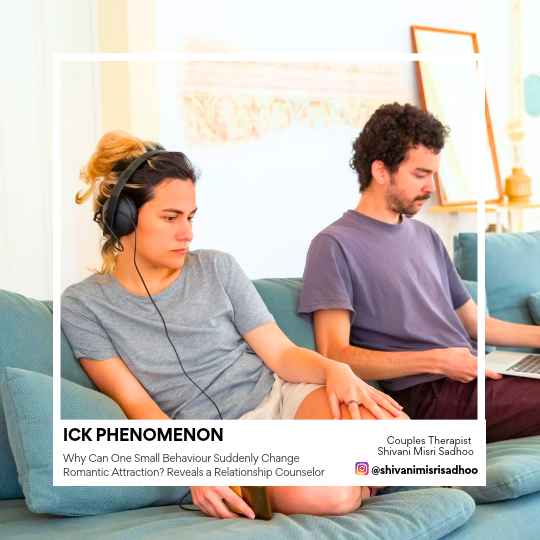
“The ‘ick’ is not always a sign that you have fallen out of love or that your partner is wrong for you. Sometimes, it reflects your own insecurities, unrealistic expectations or discomfort with emotional intimacy. Before allowing one small behavior to change how you see your partner, take a moment to understand what is really triggering that reaction.” Opines Marriage Counselor Shivani Misri Sadhoo.
We must remember that nobody is perfect. We may fall for someone’s appearance or personality, but it is their everyday behavior that ultimately determines how comfortable we feel around them.
The ‘ick’ may stem from extreme disgust sensitivity, fear of emotional proximity, ego factor, being too perfect, or the brain’s defense mechanism. However, not every little irritation signals that a relationship is wrong. Sometimes, it is important to understand whether the behavior reflects a genuine incompatibility or simply a personal preference.
Frequently Asked Questions (FAQs) on the Ick Phenomenon and its Impact on a Relationship
1. What is the “ick” phenomenon in dating and relationships?
The “ick” is a sudden, intense feeling of discomfort, repulsion, or loss of romantic attraction triggered by a minor, awkward, or seemingly harmless habit. Rather than indicating that your partner did something objectively wrong, it usually happens when a small behaviour clashes with your personal expectations or romantic ideal.
2. Why can one minor habit suddenly ruin romantic attraction?
According to relationship counselor Shivani Misri Sadhoo, a sudden loss of attraction often stems from internal psychological triggers rather than the habit itself. Key causes include heightened disgust sensitivity, perfectionism, ego-driven expectations, the brain’s overactive threat-defense mechanism, or an avoidant attachment style using minor flaws to create emotional distance.
3. Can getting the “ick” be a sign of fear of intimacy?
Yes. For people with avoidant attachment tendencies, deepening emotional proximity, vulnerability, or commitment can feel overwhelming. Subconsciously, the mind magnifies trivial habits—like how a partner eats, walks, or talks—as a protective defense mechanism to pull away from serious intimacy.
4. Does getting the “ick” mean you are incompatible with your partner?
Not necessarily. While some triggers point to genuine dealbreakers, many stem from temporary discomfort, unrealistic standards, or personal insecurities. Pausing to identify whether the reaction is rooted in true incompatibility or an internal emotional trigger helps prevent ending a healthy relationship prematurely.

Shivani Misri Sadhoo is an internationally recommended relationship counsellor by the world’s biggest and most trusted study and research-based foundation for couples therapy – Gottman Institute. She is trained in specialised key relationship counselling Skills from AIIMS, VIMHANS and various other reputed institutions. Counsellor Shivani Misri Sadhoo is also certified in emotionally focused therapy, cognitive behavioural therapy, and dialectical behaviour therapy.
Counselor Shivani Misri Sadhoo is also a Certified Neuro Linguistic Practitioner with specialized training and experience in the field of affairs/betrayals, trust issues, difficulty communicating, conflicting values, bereavement, grief and loss (affairs, separation, divorce, childhood) and emotional health issue (anxiety, social anxiety, fear, depression, low mood).
Currently, Shivani Misri Sadhoo is one of the top counselors with the HIGHEST Success Rate with over 17,000 happy couples and individuals (based in India and abroad), who has benefited from her therapy. Psychologist and Counselor Shivani Misri Sadhoo not only practices independently from her clinic in Greater Kailash, Delhi, India, but also is listed on the panel of eminent hospitals like IBS Hospital Panel – Institute of Brain and Spine, Express Clinic, Fortis (formerly) based in Delhi.
Call Counselor: +91-8860875040
Email: saarthiforlife@gmail.com