Summary
- Men who have only male friends often operate within comfort-driven social patterns shaped by upbringing, communication style, and emotional conditioning rather than simple preference.
- Their friendships may appear less expressive on the surface, but they often reflect indirect forms of loyalty, trust, and support rather than open emotional dialogue.
- Limiting social circles to one gender can provide stability, but it may also reduce exposure to diverse perspectives and emotional growth opportunities over time.
Friendships reveal more about a person than they often realize. The kind of people someone surrounds themselves with can reflect comfort zones, emotional patterns, and even past experiences. When a man has only male friends, it’s not just a random social choice—it often points toward deeper psychological tendencies shaped over time. Understanding these patterns helps uncover how men build trust, express emotions, and navigate relationships in their own way, shares Shivani Misri Sadhoo, an experienced couples therapist in Delhi.
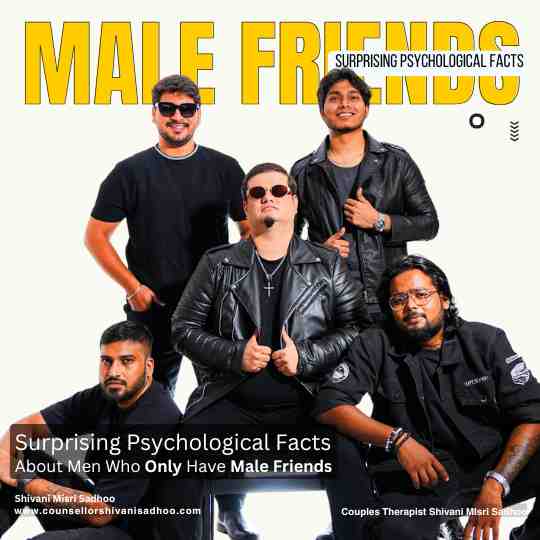
Why do some men choose to have only male friends?
It’s easy to assume that men who socialise only with other men are simply more comfortable in familiar territory. But psychology suggests something deeper is at play. Social patterns are rarely random—they’re shaped by upbringing, emotional conditioning, social expectations, and personal experiences. When a man’s circle includes only male friends, it often reflects how he processes trust, vulnerability, and connection.
Marriage counsellor and psychologist Shivani Misri Sadhoo says “A man’s social circle is not just a choice—it’s a reflection of how he understands trust, comfort, and connection in his own world.”
The Comfort of Familiar Communication Styles
Many men grow up in environments where emotional expression is limited or structured in a certain way. Conversations among male friends often revolve around activities, humour, or shared interests rather than emotional depth. This creates a predictable and low-pressure interaction style. For some men, this becomes the default comfort zone, making cross-gender friendships feel unfamiliar or even challenging.
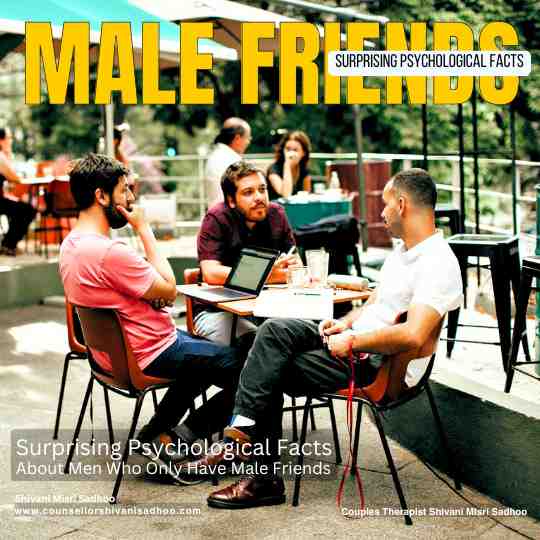
Emotional Guarding and Selective Vulnerability
A man who has only male friends may not necessarily lack emotional depth, but he may be selective about where and how he expresses it. Psychological studies suggest that men are often conditioned to manage emotions privately. Within male friendships, vulnerability may be expressed indirectly—through loyalty, support, or presence—rather than open conversation. This can make friendships feel strong yet emotionally understated.
Fear of Misinterpretation in Cross-Gender Friendships
One subtle but important factor is the fear of misunderstanding intentions. Some men avoid friendships with women because they worry their behaviour might be misread as romantic interest, or vice versa. This hesitation can lead them to stay within male-only social circles where expectations are clearer, and boundaries feel easier to manage.
Influence of Early Social Conditioning
Childhood and adolescence play a major role in shaping social comfort. Boys who grow up in male-dominated environments—such as boys’ schools, sports teams, or strict cultural settings—often develop stronger bonding patterns with other males. Over time, this becomes a habit rather than a conscious choice, reinforcing the same type of social circle into adulthood.
Shared Identity and Unspoken Understanding
Male friendships often rely on a sense of shared identity. There is an unspoken understanding of social pressures, expectations, and experiences that men go through. This creates a sense of ease—there is less need to explain oneself. For some, this shared baseline makes friendships feel more effortless compared to navigating differences in perspective.
Avoidance of Emotional Complexity
Cross-gender friendships can sometimes involve more nuanced communication, emotional awareness, and sensitivity. Men who prefer straightforward, low-complexity interactions may unconsciously avoid these dynamics. It’s not always about inability—it can simply be a preference for simplicity and predictability in social interactions.
Past Experiences Shaping Present Choices
Negative or complicated past experiences—such as rejection, misunderstandings, or emotionally difficult interactions—can influence future behavior. A man who has faced such situations may gradually limit his social interactions to spaces where he feels more in control and less exposed.
It’s Not Always a Limitation—Sometimes It’s a Choice
It’s important to recognise that having only male friends is not inherently a flaw. For some men, it reflects genuine satisfaction with their social circle. Strong friendships, regardless of gender, are defined by trust, reliability, and mutual respect. However, from a psychological perspective, limiting social exposure can sometimes reduce opportunities for broader emotional growth and diverse perspectives.
The Balance Between Comfort and Growth
Human behaviour often balances between comfort and expansion. Staying within familiar circles feels safe, but stepping outside them can lead to deeper understanding and personal development. Men who gradually engage in diverse social interactions often develop stronger communication skills and emotional awareness over time.
In the end, social choices are rarely just about preference—they are shaped by layers of experience, conditioning, and perception. Understanding these patterns doesn’t mean judging them, but recognizing how they influence connection, communication, and personal growth.

Shivani Misri Sadhoo is an internationally recommended relationship counsellor by the world’s biggest and most trusted study and research-based foundation for couples therapy – Gottman Institute. She is trained in specialised key relationship counselling Skills from AIIMS, VIMHANS and various other reputed institutions. Counsellor Shivani Misri Sadhoo is also certified in emotionally focused therapy, cognitive behavioural therapy, and dialectical behaviour therapy.
Counselor Shivani Misri Sadhoo is also a Certified Neuro Linguistic Practitioner with specialized training and experience in the field of affairs/betrayals, trust issues, difficulty communicating, conflicting values, bereavement, grief and loss (affairs, separation, divorce, childhood) and emotional health issue (anxiety, social anxiety, fear, depression, low mood).
Currently, Shivani Misri Sadhoo is one of the top counselors with the HIGHEST Success Rate with over 17,000 happy couples and individuals (based in India and abroad), who has benefited from her therapy. Psychologist and Counselor Shivani Misri Sadhoo not only practices independently from her clinic in Greater Kailash, Delhi, India, but also is listed on the panel of eminent hospitals like IBS Hospital Panel – Institute of Brain and Spine, Express Clinic, Fortis (formerly) based in Delhi.
Call Counselor: +91-8860875040
Email: saarthiforlife@gmail.com