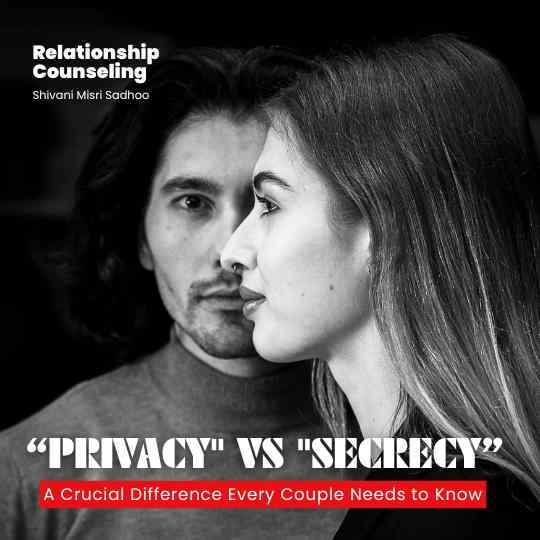
A Crucial Difference Every Couple Needs to Know
Key Summary
- Privacy is a healthy personal space that exists without guilt, while secrecy involves intentionally hiding things out of fear or discomfort.
- Privacy strengthens trust and individuality in a relationship, whereas secrecy slowly creates doubt and emotional distance.
- The key difference lies in intention—whether you’re protecting your space or avoiding the truth that could affect your partner.
Not everything in a relationship needs to be shared. And honestly, it shouldn’t be.
A lot of people believe that love means full transparency—no filters, no boundaries, no personal space. But that’s not how real relationships work. In fact, trying to know everything about each other can sometimes do more harm than good.
The real challenge isn’t about sharing more or less. It is about understanding what kind of things you are holding back—and why. That’s where the confusion between privacy and secrecy usually begins.
At a glance, they look the same. Both involve keeping things to yourself. But emotionally, they feel very different—and they affect a relationship in completely different ways, shares Shivani Misri Sadhoo, an experienced couples therapist in Delhi.
So, when does privacy start becoming secrecy?
It is not like a switch flips one day. There’s no clear moment where you can say, “Okay, now this is secrecy.”
It is more subtle than that.
Privacy feels easy. You do not overthink it. You are just… being yourself. You are not hiding anything important—you are simply not sharing every single detail. And there’s no guilt in it.
Secrecy, though, has a different energy.
You pause before speaking. You choose your words more carefully than usual. Sometimes you avoid certain topics altogether. And deep down, there’s this small thought—“What if this comes out?”
That slight discomfort? That’s usually the turning point.
Marriage counselor Shivani Sadhoo, says “Privacy is not about shutting someone out; it’s about holding on to the parts of yourself that make you whole. It allows love to exist without pressure, without constant explanation, without the need to prove anything. Secrecy, on the other hand, grows in the shadows—it is not the need for space, but the fear of being seen. And while privacy quietly strengthens trust, secrecy slowly unravels it, not in loud moments, but in the small, unnoticed distance it creates over time.” – Shivani Misri Sadhoo, Gottman Recommended Indian Marriage Counsellor | Clinical Psychologist at IBS Hospital, Lajpat Nagar, Delhi

Privacy: having space without losing connection
Even when you are deeply connected to someone, you do not stop being your own person.
You still have your own thoughts, your moods, your little habits that do not always need explaining. Maybe you like sitting alone for a while. Maybe you do not share every conversation you had during the day. Maybe you keep certain feelings to yourself until you fully understand them.
That’s normal.
And more importantly, it is healthy.
When your partner respects that space, it doesn’t feel like distance—it feels like trust. There’s no pressure to report everything constantly. No feeling of being watched or questioned. And strangely enough, that kind of freedom makes the relationship feel more real. You are not performing. You are just showing up as you are.

Secrecy: when something doesn’t feel right anymore
Secrecy usually doesn’t start as something big.
It begins with small things. Something you do not mention. Something you slightly twist. Something you think is “not worth bringing up.”
And maybe, at first, it really does feel harmless.
But if you look closely, the reason behind it is different. You are not keeping it to yourself because it is personal—you are keeping it because you are unsure how your partner would react. Or because you know it might create an issue.
That’s where it shifts.
Over time, this changes how you behave. You become a bit more careful, a bit more guarded. You think twice before saying things you wouldn’t even think about earlier.
Your partner might not know what’s going on. But they can sense the difference. And that’s where distance quietly starts building.

Why does trust make all the difference?
Trust is what allows privacy to exist without problems.
When trust is there, your partner doesn’t feel the need to question everything. They do not assume the worst just because you didn’t share something small. There’s a sense of stability.
Secrecy slowly disturbs that.
Not always in a dramatic way. Sometimes it is just small doubts. A change in tone. A feeling that something is being held back.
And once that doubt enters, it doesn’t just stay in one place. It spreads. It shows up in conversations, reactions, even silence.
How does it affect the closeness between two people?
Being close to someone isn’t about knowing every detail of their life.
It is about feeling like they’re real with you.
Privacy actually supports that feeling. When you are allowed to have your own space, you do not feel suffocated. You come back into the relationship feeling more like yourself.
Secrecy does the opposite.
It creates a gap—not always visible, but definitely felt. Conversations lose a bit of honesty. Reactions become slightly controlled. And over time, the natural comfort you once had starts fading.
Finding that balance in real life
There’s no perfect formula for this. Every relationship is different.
But there’s one simple question that can help:
Am I keeping this because it is mine, or because I do not want them to know?
That difference matters more than anything else.
Not everything needs to be shared. But the things that could affect your partner or the relationship? Those usually shouldn’t be hidden.
In the end…
Privacy isn’t a problem. It is actually part of what keeps a relationship healthy. It gives both people room to breathe, think, and stay connected to themselves.
Secrecy, though, slowly changes the tone of a relationship—even if it starts small.
A strong relationship doesn’t demand that you share everything.
But it does need honesty where it truly counts.
Because in the end, it is not really about what you keep to yourself— it is about whether you are doing it peacefully… or hiding it quietly.

Shivani Misri Sadhoo is an internationally recommended relationship counsellor by the world’s biggest and most trusted study and research-based foundation for couples therapy – Gottman Institute. She is trained in specialised key relationship counselling Skills from AIIMS, VIMHANS and various other reputed institutions. Counsellor Shivani Misri Sadhoo is also certified in emotionally focused therapy, cognitive behavioural therapy, and dialectical behaviour therapy.
Counselor Shivani Misri Sadhoo is also a Certified Neuro Linguistic Practitioner with specialized training and experience in the field of affairs/betrayals, trust issues, difficulty communicating, conflicting values, bereavement, grief and loss (affairs, separation, divorce, childhood) and emotional health issue (anxiety, social anxiety, fear, depression, low mood).
Currently, Shivani Misri Sadhoo is one of the top counselors with the HIGHEST Success Rate with over 17,000 happy couples and individuals (based in India and abroad), who has benefited from her therapy. Psychologist and Counselor Shivani Misri Sadhoo not only practices independently from her clinic in Greater Kailash, Delhi, India, but also is listed on the panel of eminent hospitals like IBS Hospital Panel – Institute of Brain and Spine, Express Clinic, Fortis (formerly) based in Delhi.
Call Counselor: +91-8860875040
Email: saarthiforlife@gmail.com